Rotating machinery such as gas turbines, centrifugal compressors, and steam turbines sit at the center of production for refineries, LNG plants, and power stations. A bearing failure or a rotor crack does not merely stop a machine; it can lead to fire, explosion, or total plant shutdown, with repair costs reaching millions. The protection system that sits between the machine and that outcome must be independent, deterministic, and fast. It cannot rely on the same control system that is managing the process, because a process upset is exactly when protection is needed most. A Bently Nevada PLC system is purpose-built for this role. It is a dedicated machinery protection platform that monitors vibration, axial position, speed, and temperature, and then executes a hard-wired trip when a parameter crosses a safe limit. For a procurement team, understanding why this system is important is the basis for evaluating whether a supplier can deliver the right configuration, documentation, and lifecycle support.
This guide explains the role of a Bently Nevada PLC system in rotating machinery protection from a buyer’s perspective. It covers the architectural principle of independence, the monitoring and trip functions that matter, the specifications that should appear in a purchase order, and the verification steps before sourcing. The technical points are drawn from the Bently Nevada 3500 series platform, which is widely deployed in critical turbomachinery applications and referenced in industry guidance for compressor protection. The goal is to help buyers ask the right questions and interpret supplier data correctly.
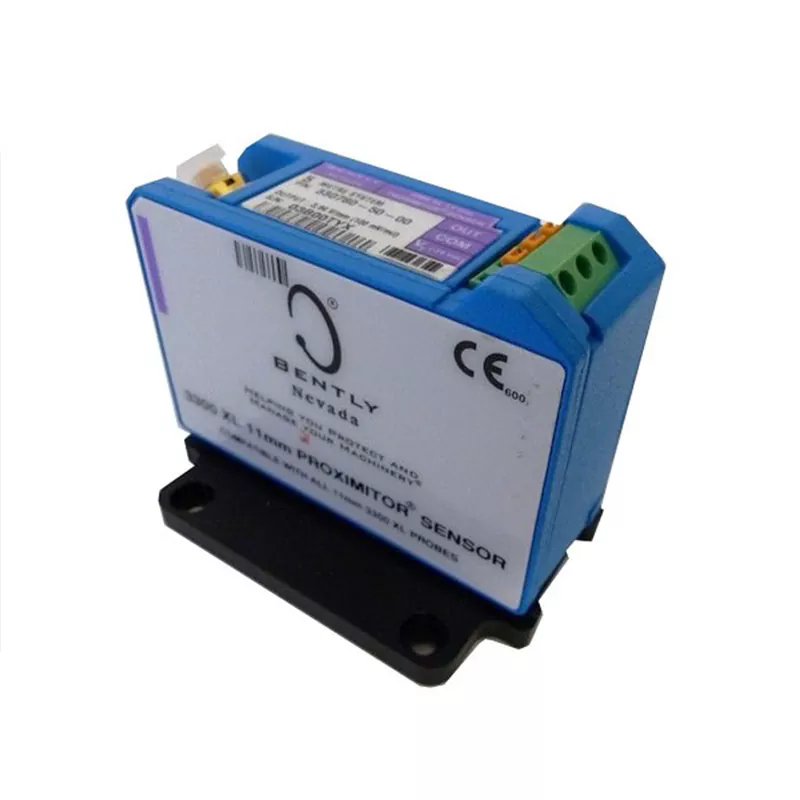
The most important word in rotating machinery protection is independence. A distributed control system (DCS) or a plant PLC manages the process: it adjusts valves, modulates speed, and optimizes throughput. When a process upset occurs, the control system may be saturated, operating outside its normal range, or even initiating corrective actions that conflict with protection logic. If the protection function is implemented inside the same control system, a single fault or a software anomaly can disable both control and protection simultaneously. This is why industry standards such as API 670 require an independent protection layer. The protection system must be capable of detecting an unsafe condition and executing a trip without depending on the process control system, its software, or its communication network.
A Bently Nevada PLC system, such as the 3500 series, is architecturally designed to satisfy this requirement. It uses a separate rack, separate power supplies, separate input modules, and a hard-wired relay output path for the trip signal. The monitoring data can be shared with the DCS through Modbus or Ethernet for trending and diagnostics, but the trip decision and the relay action remain inside the protection rack. This separation is not a convenience feature; it is the core safety principle. The table below contrasts the two architectures.
| Architecture | Protection Integrated in DCS/PLC | Independent Bently Nevada PLC System |
| Trip path | Software-dependent, shares processor and network | Hard-wired relay path, independent of control system |
| Response determinism | Variable with controller scan time and network load | Dedicated, typically under 10 ms from sensor to relay |
| Failure mode | Common-cause failure can disable control and protection | Protection remains functional during control system faults |
| Standard compliance | May require additional justification for API 670 | Designed to meet API 670 independent protection layer requirements |
Our factory at Yueyang Tongtu E-commerce Co., Ltd. supplies Bently Nevada PLC hardware with a focus on the independent protection architecture that critical machinery requires. We work with buyers to confirm that the rack configuration, the relay modules, and the power supplies are specified as a dedicated protection layer, not as an add-on to a process controller. This distinction is the first question a procurement team should ask when sourcing a protection system.
A Bently Nevada PLC system performs three functions that are distinct from ordinary condition monitoring. The first is continuous measurement of the parameters that indicate machinery health: radial vibration, axial position, speed, keyphasor reference, and bearing temperature. The second is comparison of those measurements against configured alarm and trip setpoints, with voting logic that reduces the risk of a false trip while maintaining protection integrity. The third is execution of the trip output through a relay module that is independent of the monitoring electronics. The 3500 series implements these functions through dedicated I/O modules: the 3500/42M for vibration, the 3500/45 for axial position, the 3500/53 for speed, the 3500/62 for temperature, and the 3500/50 or 3500/51 for relay outputs. The table below maps the functions to the modules and the procurement questions they raise.
| Function | Typical Module | Procurement Question |
| Radial vibration monitoring | 3500/42M | Channel count and transducer compatibility |
| Axial position / thrust | 3500/45 | Measurement range and API 670 compliance |
| Speed and overspeed | 3500/53 | Redundancy configuration |
| Bearing temperature | 3500/62 | RTD or thermocouple input type |
| Trip relay output | 3500/50 or 3500/51 | Voting logic (2oo3 or 2oo2) and SIL capability |
The voting logic is a procurement point that deserves attention. A simple single-channel trip is susceptible to false trips from a faulty sensor. A dual-channel “2oo2” configuration trips only when both channels agree, which reduces false trips but also reduces availability if one channel fails. A triple modular redundant (TMR) configuration with “2oo3” voting provides both high availability and high safety integrity, and the 3500 series supports TMR relay modules for this purpose. The buyer should specify the voting architecture based on the machine’s criticality and the operator’s tolerance for nuisance trips. This is not a decision that should be left to the supplier’s default configuration.
A purchase order for a Bently Nevada PLC system should specify the parameters that determine whether the system will protect the machine as intended. These include the channel count and module mix, the safety integrity level, the response time, the communication interfaces, and the environmental rating. The safety integrity level is often the most misunderstood specification. A single-channel configuration is typically suitable for SIL 2, while a redundant or TMR configuration can reach SIL 3. The buyer should confirm that the specified SIL matches the safety requirement of the machine and that the supplier can provide the certificate or assessment that supports the claim.
The table below provides a procurement specification checklist for a Bently Nevada PLC system.
| Specification | Typical Range / Option | Why It Matters |
| Rack size | 14-slot 19-inch rack, local or remote | Determines channel capacity and installation location |
| Safety integrity | SIL 2 single-channel; SIL 3 redundant/TMR | Must match the machine safety requirement |
| Response time | Under 10 ms from sensor to relay | Fast enough to limit damage from a fault event |
| Communication | Modbus TCP, Ethernet, 4–20 mA | Integration with DCS and asset management |
| Operating temperature | 0°C to +65°C | Matches the installed environment |
| Certification | API 670, IEC 61508, ATEX/FM/CSA as required | Confirms compliance with industry and site standards |
Our factory at Yueyang Tongtu E-commerce Co., Ltd. supplies Bently Nevada PLC modules and rack components with documentation that supports these specifications. We advise buyers to include the voting architecture, the SIL target, and the response time requirement in the inquiry, because these parameters determine the module selection and the price. A supplier that can quote against a complete specification is a supplier that understands the protection function, not just the part number.
Buyers can verify system integrity by requesting documentation and performing targeted checks before the order is placed. The verification should confirm that the module is genuine, that the firmware or configuration is compatible with the existing rack, and that the relay path is functional. For a new system, the verification should include the factory acceptance test report and the SIL certificate. For a replacement or expansion, the verification should include the rack configuration file and the module compatibility data. The table below provides a verification checklist.
| Verification Item | What to Request | What It Confirms |
| Product authenticity | Original packaging, traceable part number | Genuine Bently Nevada hardware |
| Configuration compatibility | Rack configuration file, firmware version | Integration with existing system |
| Functional test | Relay actuation test, channel response check | Trip path integrity |
| Safety documentation | SIL certificate or assessment report | Claimed safety integrity level |
| Environmental certification | ATEX, FM, CSA certificates as applicable | Site compliance |
Our factory at Yueyang Tongtu E-commerce Co., Ltd. supports buyers with product traceability and configuration data for Bently Nevada PLC hardware. We understand that a protection system is only as reliable as its weakest module, and we help our customers confirm compatibility before shipment. The verification process is not a formality; it is the step that separates a protection system that will operate from one that will sit in the rack as a silent liability.
A Bently Nevada PLC system is important for rotating machinery protection because it provides an independent, deterministic layer between the machine and a catastrophic outcome. It monitors the parameters that indicate distress, it applies voting logic to reduce false trips, and it executes a hard-wired trip through a relay path that does not depend on the process control system. For procurement teams, the value of the system is realized only when the specification covers the voting architecture, the safety integrity level, the response time, and the verification documentation. Our factory at Yueyang Tongtu E-commerce Co., Ltd. supplies Bently Nevada PLC hardware with the traceability and technical support that these requirements demand.
If you are sourcing a Bently Nevada PLC system for turbine, compressor, or other critical rotating machinery protection, contact our team to discuss the configuration, the safety target, and the documentation package. We are ready to support your procurement and qualification process.
Question 1: Why is a Bently Nevada PLC system preferred over a standard PLC for machinery protection?
Answer: A standard PLC shares its processor, power supply, and network with the control function. If the control system experiences a fault, the protection function may be compromised. A Bently Nevada PLC system, such as the 3500 series, is a dedicated protection platform with its own rack, power, input modules, and hard-wired relay output. It is designed to remain functional when the control system is not, which is the core requirement of an independent protection layer under API 670.
Question 2: What is the difference between SIL 2 and SIL 3 in a Bently Nevada PLC configuration?
Answer: SIL 2 is typically achievable with a single-channel or dual-channel architecture, depending on the proof-test interval and the hardware fault tolerance. SIL 3 generally requires a redundant or triple modular redundant (TMR) configuration with voting, such as dual 3500/42M modules paired with a 3500/51 TMR relay module. The buyer should confirm the target SIL with the machine safety assessment and request the supplier’s SIL certificate or assessment report for the proposed configuration.
Question 3: How fast does a Bently Nevada PLC system need to respond to a trip condition?
Answer: The response time from sensor input to relay actuation in a 3500 series system is typically under 10 milliseconds. This speed is important because a bearing seizure or rotor rub can escalate within milliseconds. The buyer should specify the required response time in the purchase order and confirm that the proposed module and relay combination meets that requirement.
Question 4: Can a Bently Nevada PLC system share data with the plant DCS?
Answer: Yes. The protection rack can communicate vibration, position, speed, and temperature data to the DCS or an asset management system through Modbus TCP, Ethernet, or 4–20 mA outputs. The important principle is that the data-sharing path is separate from the trip path. The DCS receives monitoring data for trending and diagnostics, but the trip decision and the relay action remain inside the protection rack. This separation preserves the independence of the protection layer.
Question 5: What documentation should a supplier provide to verify a Bently Nevada PLC system?
Answer: A supplier should provide product traceability, the rack configuration file or compatibility data, the functional test report for the relay and input channels, the SIL certificate or assessment report for the configured system, and the environmental certificates such as ATEX, FM, or CSA as applicable to the installation site. A supplier that provides this documentation is a supplier that can support the verification process before the system is placed into service.
Contact Yueyang Tongtu E-commerce Co., Ltd. today to discuss your Bently Nevada PLC requirements for rotating machinery protection and to request the configuration and documentation package that supports your procurement decision.
-